
Transactional leadership is a leadership style that is characterized by a leader-follower exchange in which the follower receives a reward in return for compliance with leader’s expectations (Bass & Avolio, 1994). It involves a leader-follower exchange relationship in which the follower receives some reward related to lower-order needs in return for compliance with the leader’s expectations.
an excerpt from the book
Technology continues to change how organizations work, communicate, and make decisions, but effective leadership still depends heavily on people. As information technology professionals move into increasingly visible leadership positions, technical knowledge alone may not be enough.
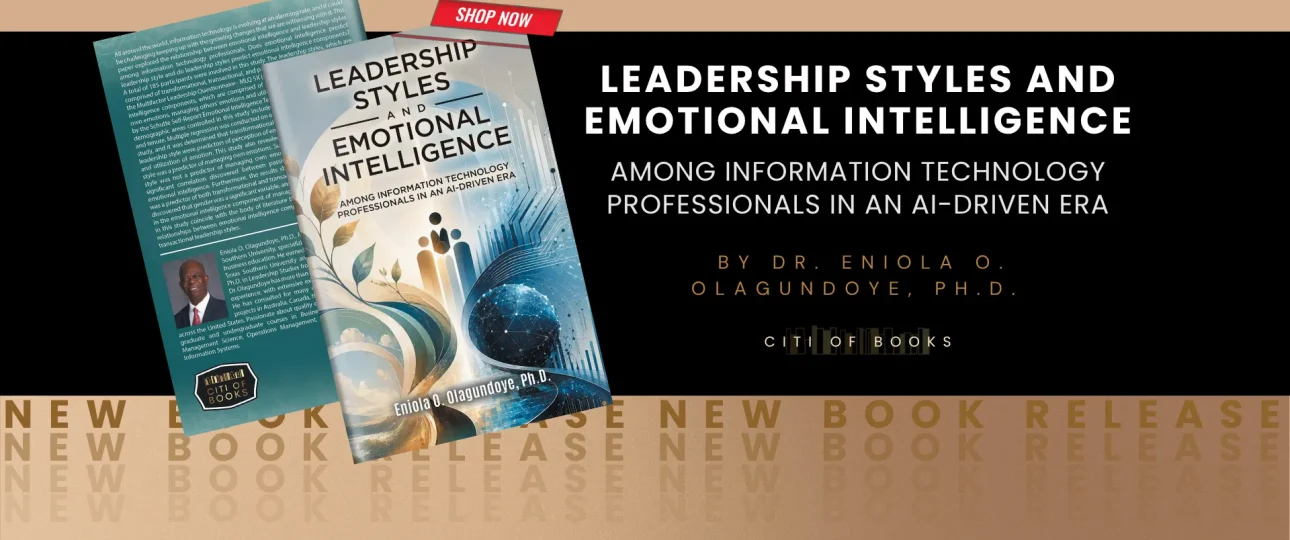
“Leadership Styles and Emotional Intelligence Among Information Technology Professionals in an AI-Driven Era” by Dr. Eniola O. Olagundoye, Ph.D. examines the connection between emotional intelligence and leadership styles among IT professionals, offering a research-based look at how leaders understand emotions, manage relationships, and guide others in a technology-driven environment. Proudly published by Citi of Books, this is now available on Amazon, Barnes & Noble, and other major retail platforms.
Eniola O. Olagundoye, Ph.D., MBA, serves on the faculty at Texas Southern University, specializing in Information Technology and business education. He earned his B.B.A. in General Business from Texas Southern University and his M.B.A. in Management and Ph.D. in Leadership Studies from Our Lady of the Lake University. Dr. Olagundoye has more than 25 years of Information Technology experience, with extensive expertise in SAP enterprise systems.
He has consulted for many clients worldwide and completed projects in Australia, Canada, the United Arab Emirates, India, and across the United States. Passionate about quality education, Dr. Olagundoye teaches graduate and undergraduate courses in Business Administration, Management, Management Science, Operations Management, Cybersecurity, and Management Information Systems.
The study begins with a practical observation: information technology has moved from being primarily a support function to playing a central role in organizational

strategy and operations. With this shift comes a greater need for IT professionals to develop the interpersonal and leadership skills required to work effectively with people. The research specifically explores whether emotional intelligence and leadership styles are connected among IT professional leaders, while taking gender, age, ethnicity, education, and tenure into account.
Dr. Olagundoye focuses on three leadership styles: transformational, transactional, and passive-avoidant leadership. The study also examines four components of emotional intelligence: perception of emotion, managing one’s own emotions, managing others’ emotions, and utilization of emotion. These concepts provide the foundation for examining how leaders respond to their own emotions, recognize what others may be experiencing, and use emotions as part of problem-solving and leadership.
The book is particularly relevant for IT leaders, managers, business professionals, educators, students, researchers, and organizations interested in leadership development. Its findings also offer a starting point for further research, with the author recommending studies involving IT professionals across industries such as oil and gas, manufacturing, academia, retail, banking, and pharmaceuticals, as well as larger samples and additional measurement instruments.
The book invites readers to look more closely at the relationship between emotional intelligence and leadership, and to consider how stronger human skills can complement technological expertise in the leaders of today and tomorrow.
Grab your copy of “Leadership Styles and Emotional Intelligence Among Information Technology Professionals in an AI-Driven Era” by Dr. Eniola O. Olagundoye, Ph.D. through the buttons below: