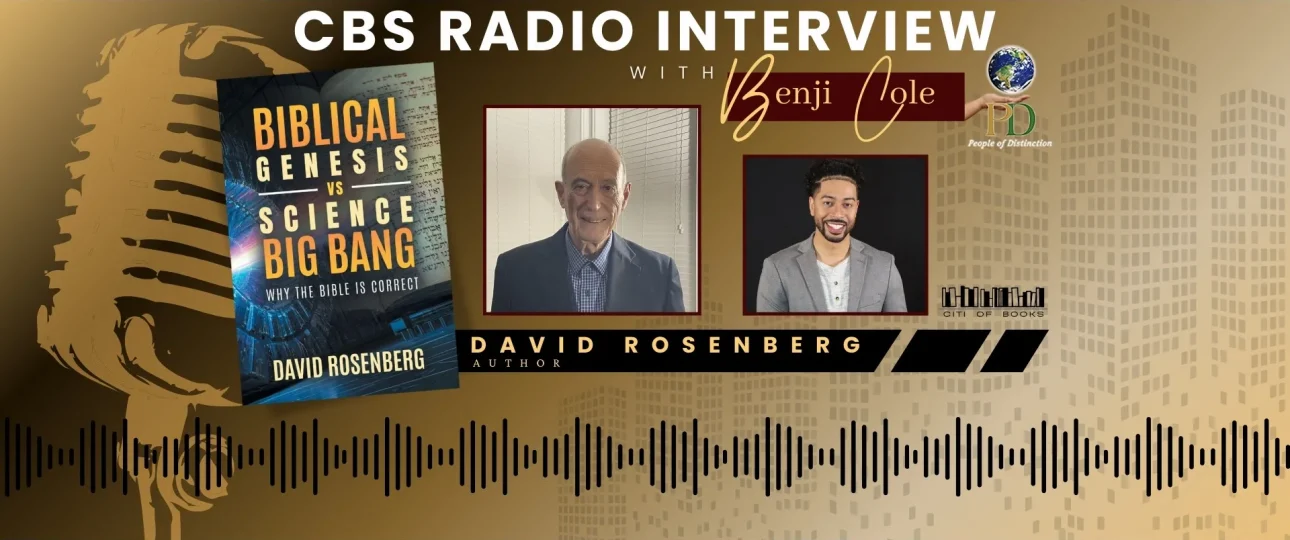
When it comes to providing information to the public or introducing a brand, a radio interview is one of the best mediums to use. That is why Citi of Books Publishing cooperated with People of Distinction CBS Radio’s host, Benji Cole, for the inspiring and amazing stories behind every author’s work to be heard.
People of Distinction is a platform for professional and even enthusiast authors to engage in a genuine discussion and learn on inspirations, themes, and narratives from blossoming authors.
This program is hosted by Benji Cole, son of Al Cole, and is the ideal platform for authors who want to widen their readership. Benji Cole is an awesome Los Angeles actor and filmmaker who conducts interviews with guest authors. Take part in the CBS Radio Interview and become a notable guest on one of the most renowned radio shows in the country.
This extensively broadcast talk show has already conducted interviews with 2,000 of the most remarkable people in America over the past few years, including NBC producer Ken Corday and former CBS Morning News anchor Bill Kurtis. Authors who land a spot on this radio interview program will undoubtedly reach millions of listeners who could end up being book customers courtesy of CBS’ prominence and extensive national reach.
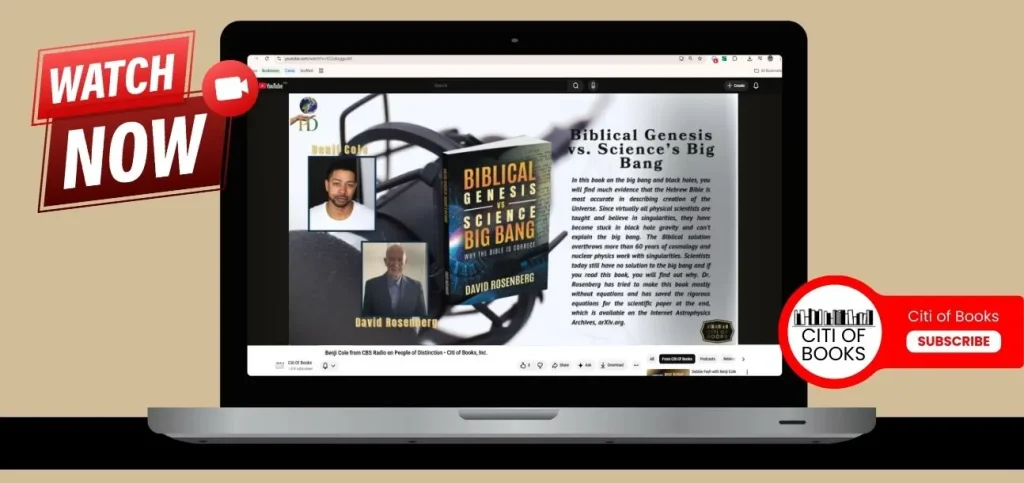
The author of the book “Biblical Genesis vs. Science’s Big Bang” David Rosenberg, was interviewed by Benji Cole of CBS Radio. They talked about the in-depth nature of the book’s theme and inspiration during the interview.
“Biblical Genesis vs. Science’s Big Bang” is a faith based, science engaged work by Dr. David Rosenberg that takes on the longstanding debate between the biblical creation narrative and the scientific Big Bang theory. Rather than simply dismissing modern cosmology, Rosenberg argues that the Hebrew Bible offers a more accurate description of the universe’s origin, and he sets out to show why the standard scientific explanations—especially those rooted in singularities and black hole models—fall short.
David Rosenberg holds a bachelor’s degree in chemical engineering from New York Polytechnical Institute, a master’s in chemical engineering from New Jersey Institute of Technology, and a doctorate degree from SUNY Brooklyn. He has worked for Naugatuck Chemical on polymerization models and for combustion engineering on large chemical plants and nuclear models. After taking advanced physics courses at NJIT and Princeton, he worked with Edward (Rocky) Kalb on nucleosynthesis of the big bang. He used a big bang model based on the Bible to post a number of papers on the internet astrophysics archives. While in the LSU Relativity Group Loni Hyrel 17, he worked on black hole formation models on the computer. At the same time, he preferred a biblically based model that explains dark matter, dark energy, missing antimatter, and everything else.
This book offers a compelling invitation to rethink familiar debates. Rosenberg takes on one of history’s most contested subjects—the origin of the universe—and reframes it entirely. Rather than positioning science and faith as opposing forces, he contends that the Hebrew Bible provides a more coherent and accurate explanation of creation than modern cosmology has yet achieved.
Throughout the book, Rosenberg points to what he believes is a fundamental flaw in contemporary scientific thinking: the reliance on singularities. He argues that this assumption has confined physicists to models that remain unresolved, particularly in discussions of black holes and the Big Bang. While science continues to wrestle with what truly initiated the universe, Rosenberg introduces a faith-centered perspective, suggesting that ancient biblical texts may contain insights long overlooked by modern theory.
Whether you approach the topic as a believer, a skeptic, or simply someone eager to explore new ideas, “Biblical Genesis vs. Science’s Big Bang” invites reflection and discussion that extend well beyond its final pages. It challenges entrenched assumptions, encourages thoughtful debate, and reminds readers that the search for truth remains an open and evolving journey.
In a world where science and faith are often portrayed as irreconcilable, Rosenberg boldly brings them into dialogue—resulting in a thought-provoking read that’s hard to put down and even harder to forget.
Listen to the full interview below.