
Psychopaths may appear sympathetic toward their loved ones but will humiliate them and undermine them in front of the victim and behind their backs to friends and family because the psychopath does not want the outside world to know they are the problem; the victim is the problem.
an excerpt from the book
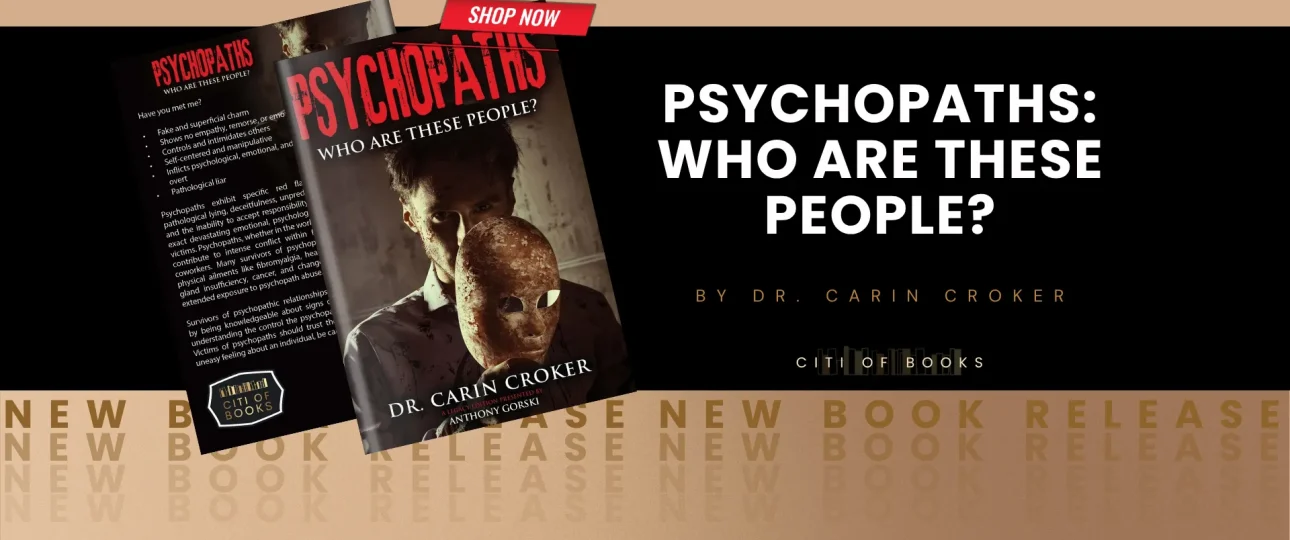
When most people hear the word psychopath, they probably imagine a violent criminal, a serial killer, or a frightening character from a movie. Dr. Carin Croker’s “Psychopaths: Who Are These People?” challenges that familiar image. Proudly published by Citi of Books, the book is now available on Amazon, Barnes & Noble, and other major retail platforms.
Dr. Carin Croker brings approximately 30 years of personal and professional exposure to the subject of psychopathy. Her work has included examining academic research, scholarly literature, documentaries, books, and personal and professional observations. Her academic background includes research into behaviors associated with psychopaths in female health-care executives, contributing to her particular interest in psychopathy and leadership within health-care organizations.
Through her work, Dr. Croker hopes to promote greater education and awareness while giving attention to individuals who have experienced psychopathic or pathological behavior in their personal and professional lives. Dr. Croker lives in Milwaukee, Wisconsin, with her rescue goldendoodle, Ozzy.
What comes to mind when you hear the word psychopath? For many people, the term immediately brings to mind images of violent criminals or fictional villains. In her book, Dr. Carin Croker invites readers to look beyond these familiar stereotypes and consider psychopathy from a broader perspective. With “Psychopaths: Who Are These People?”, Dr. Croker brings her experience and research together in a book intended to encourage greater awareness of a subject that is often misunderstood.
Rather than relying solely on the familiar image associated with the word “psychopath,” the book looks at the subject within the context of everyday communities, relationships, professional environments, and leadership. At its heart, the book reflects Dr. Croker’s interest in helping readers become more informed and aware of behaviors that can have a destructive impact on individuals and organizations.
Ultimately, “Psychopaths: Who Are These People?” is less about frightening readers with stories of criminals and more about challenging readers to recognize destructive patterns that may be hidden behind normal appearances. The book asks us to look beyond charm. Beyond titles. Beyond professional success. Beyond first impressions. And beyond the assumption that dangerous behavior always looks dangerous.
Its strongest message is that education and awareness can help individuals and organizations respond earlier to harmful behavior. For employees, that may mean recognizing patterns of manipulation and abuse. For organizations, it may mean creating stronger reporting systems, healthier workplace cultures, and clearer accountability. For survivors, it may mean understanding that abusive behavior is not automatically their fault. And for researchers and mental-health professionals, the book makes a case for continuing to study psychopathy outside prisons and other traditional settings.
Psychopathy remains a complicated and controversial subject. But Dr. Carin Croker’s book of “Psychopaths: Who Are Therse People?” makes one thing clear: if we only look for the stereotypical monster, we may overlook the destructive behavior happening in ordinary places. Sometimes the warning signs are not found in how frightening someone appears. They are found in what repeatedly happens to the people around them.
Grab your copy of “Psychopaths: Who Are These People?” by Dr. Carin Croker through the buttons below: